

Product Overview
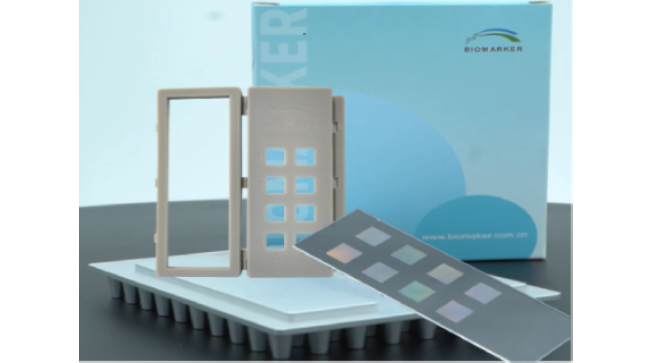
BMKMANU S1000 Advantages

Multi-level Resolution Adjustment
The BMKMANU S1000 spatial transcriptomics chip supports dynamically adjustable resolution from 100 um to 4.8 um.

HE Staining Preserved
The BMKMANU S1000 chip preserves on-slide HE staining; combined with high-resolution spot clustering, it delivers more accurate results.

Flexible Capture Area Customization
The BMKMANU S1000 chip supports flexible customization of 1 to 8 capture areas.

Subcellular Resolution
The average diameter of a mammalian somatic cell is 10 um, whereas the BMKMANU S1000 chip achieves a resolution of 4.8 um, reaching the subcellular level.
Better Compatibility with Nanopore Long-Read Data
Both the correlation of UMI/Gene counts per spot between short-read and long-read data and the t-SNE/UMAP dimensionality reduction clustering show very high consistency. This demonstrates that the BMKMANU S1000-Nanopore full-length transcriptome product can independently perform data demultiplexing and mining analysis without relying on NGS data correction.
Nanopore effectively assigned nearly 50%
| Nmuber of Reads | Number of Base | Reads with Valid Barcode | Bases with Valid Barcodes | N50 | Bases Mapped to Transcriptome And with Valid Barcode |
| 105,553,898 | 70,516,281,320 | 73.85% | 73.42% | 740 | 49.55% |

UMI counts per spot

Gene counts per spot
Technical Principle

Workflow


Selected Benchmark Data of BMKMANU S1000
Example 1: Rat Embryo Tissue
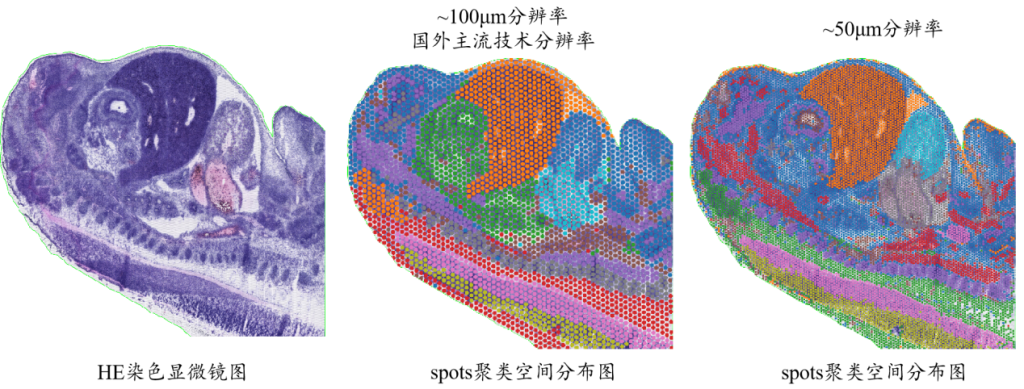
BMKMANU S1000 achieves a maximum resolution of 4.8 um, nearly 400 times higher than current mainstream spatial transcriptomics chips. At high resolution, HE-stained tissue morphology aligns more closely with the spot clustering map, enabling more accurate identification of spatial gene expression heterogeneity and region-specific features.
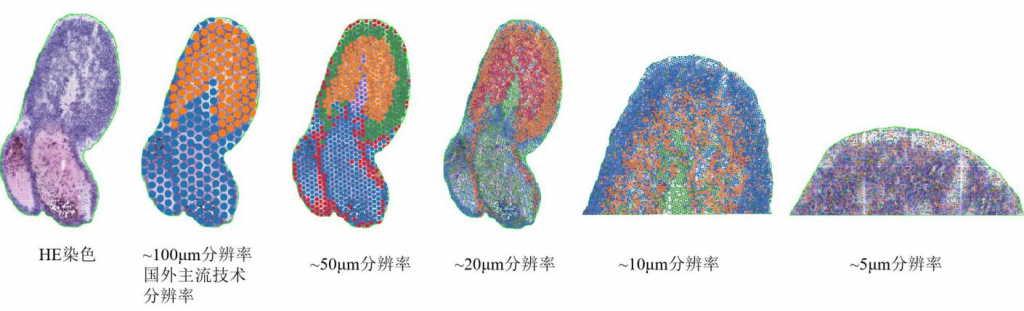
The BMKMANU S1000 spot diameter is 2.5 um, allowing tissue subpopulations to be re-clustered at multiple resolution levels; higher resolution yields more distinct tissue region clusters.
Example 2: BMKMANU S1000-Nanopore Long-Read
Alternative Splicing Analysis


Fusion Gene Analysis


Example 3: BMKMANU S1000 Benchmark Results Across Different Samples

Through continuous R&D and testing, BMKMANU S1000 has completed many sample tests, and the benchmark data show good performance across a wide range of samples.