
BMKManu S3000 — Taking Spatial Omics Research One Step Further!
Spatial ATAC-seq Technology Officially Launched — the BMK S-Series Chip Upgraded Again!
2025-07-09
BMKMANU S3000-VDJ || BMK Single-Cell-Level Full-Length Spatial Immune Repertoire Achieves a Major Research Breakthrough
2025-09-03
Single-Cell Level Spatial Transcriptomics Platform: BMKMANU S3000
BMKMANU S3000 enables whole transcriptome spatial analysis at single-cell resolution, built upon our proprietary microwell-array architecture, with barcoded microspheres loaded into each well. A total of 4,144,770 spots are arranged across a 6.8 × 6.8 mm capture area, with each bead conjugated to ~105 oligos. This high-density bead and oligo configuration achieves subcellular resolution while maintaining high capture efficiency. Integrated with high-definition H&E and fluorescence imaging, our proprietary image stitching and calibration technology supports precise cell segmentation and clustering. BMKMANU S3000 is compatible with mainstream second- and third-generation sequencing platforms, as well as multi-omics workflows including BCR-seq & TCR-seq and ATAC-seq.

- Subcellularresolution (5 μm)
- Multiple capturearea sizes are available to suit diverse applications
- Excellent RNA capture performance with ~88% effectivecapture area
- Reduced lateral RNA diffusiondue to bump slide surface
- Precise cell segmentation based on high-definition H&E and fluorescence imaging, as well as proprietary image stitching and calibration technology
- Compatible with second- and third-generationsequencing platforms: Illumina, MGI, GeneMind, ONT, PacBio, etc.
- Compatible with multiomics workflows, includingBCR-seq/TCR-seq and ATAC-seq
Multiple capture area sizes are available to suit diverse applications

Proprietary image stitching and calibration technology based on microsphere array


Precise cell segmentation
Cell segmentation for animal cells

Cell segmentation for plant cells

Compatible with multiomics workflows, including BCR-seq & TCR-seq and ATAC-seq

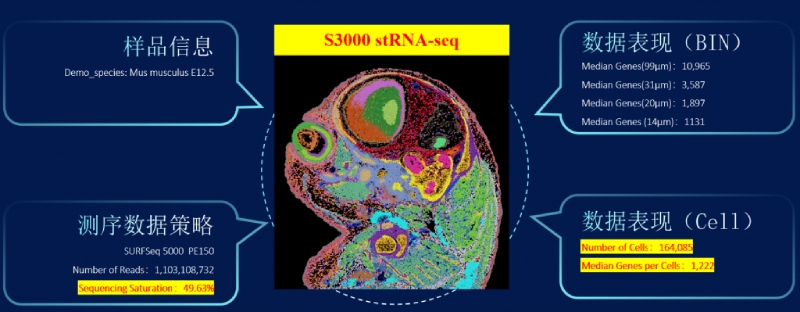
Case Study of S3000 Spatial Transcriptomics Platform
Sample: Mouse brain
Sequencing Mode: NovaSeq6000 PE150
Number of Reads: 1,647,163,344
Sequencing Saturation: 68.67%
Number of Cells: 94,020
Median Genes per Cell: 1,999
Median Genes (100μm): 11,007
Median Genes (30μm): 3,793
Median Genes (18μm): 2,026
Median Genes (6μm): 510