

BMKMANU S3000-VDJ || BMK Single-Cell-Level Full-Length Spatial Immune Repertoire Achieves a Major Research Breakthrough
BMKManu S3000 — Taking Spatial Omics Research One Step Further!
2025-09-02
The Perfect Pair! An Indispensable Golden Combination in Spatiotemporal Omics!
2026-01-14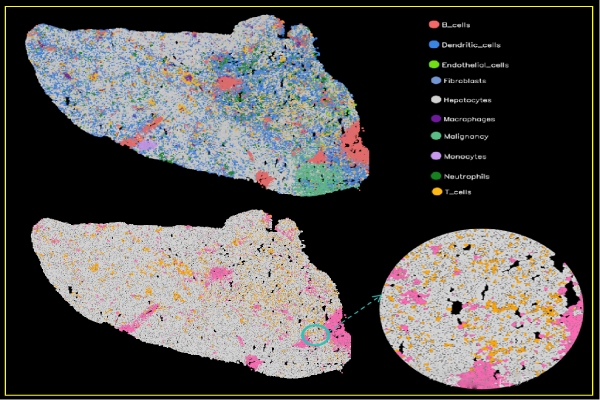
The evolution of immunomics technology
“For treating a person bitten by a rabid dog: kill the dog that bit him, take its brain and apply it as a dressing, and the disease will not recur.” — Ge Hong, Eastern Jin Dynasty, Zhou Hou Bei Ji Fang (Handbook of Prescriptions for Emergencies)
 With the gradual development of immunology, immunomics technology also entered a period of rapid growth, successively giving rise to labeled immunoassay technology, immunohistochemistry, bulk T/BCR sequencing, and the single-cell T/BCR sequencing technology that has emerged in recent years, driving progress in related sciences.

In 2017, the research group of Academician Zhang Zemin analyzed liver cancer-associated T lymphocytes using large-scale single-cell sequencing, depicting an atlas of immune cells in the liver cancer microenvironment at the single-cell level and identifying potential targets for liver cancer immunotherapy. This also laid the foundation for a systematic, multi-angle understanding of the characteristics of liver cancer T lymphocytes. (2017, Cell, Landscape of Infiltrating T Cells in Liver Cancer Revealed by Single-Cell Sequencing)

In 2024, Academician Fan Jia and Prof. Gao Qiang of Zhongshan Hospital Affiliated to Fudan University, Researcher Zhang Xiaoming of the Shanghai Institute of Immunity and Infection, Chinese Academy of Sciences, and Prof. Guo Guoji of the School of Basic Medical Sciences, Zhejiang University, jointly published a research paper titled A blueprint for tumor-infiltrating B cells across human cancers in Science. Combining single-cell transcriptomics, B-cell receptor immune repertoire and epigenomic multi-omics data, the study systematically characterized the heterogeneity, dynamic differentiation and epigenetic regulatory mechanisms of tumor-infiltrating B cells, and innovatively revealed the cancer-type preference, spatial localization features, clinical significance and potential induction and regulatory mechanisms of the widely present EF response in the tumor microenvironment.
However, unlike the increasingly mature single-cell T/BCR sequencing, spatial T/BCR sequencing technology has yet to be well supported by sequencing technology products, and results remain scarce; existing published work is still limited to relying on early low-resolution transcriptomics chips. The lack of mature, stable, high-resolution spatial T/BCR sequencing technology products has constrained research in spatial immunomics.
BMK spatial full-length immune repertoire sequencing technology BMKMANU S3000-VDJ
In December 2024, BMK Intelligent Manufacturing (Biomarker), building on the widely acclaimed subcellular-resolution S-series spatial transcriptomics chips, developed a spatial T/BCR sequencing technology product capable of simultaneously capturing 3′-end transcriptome information as well as full-length B-cell receptor (BCR) and T-cell receptor (TCR) sequences on the original slide — BMKMANU S3000-VDJ — which fills the gap in this category of technology products.

Case study — a tumor sample: BMK single-cell-level spatial immune repertoire results
The BMKMANU S3000-VDJ technology uses fresh OCT-embedded samples to capture 3′-end mRNA and full-length TCR/BCR on the same tissue section (10μm) on a chip with 3.5 μm resolution. Leveraging the proprietary image calibration and cell segmentation technology of BMK Intelligent Manufacturing, single-cell-resolution spatial transcriptomics results and single-cell-resolution spatial T/BCR data are obtained.

Technical workflow of BMKMANU S3000-VDJ
Precise spatial cell annotation
The resulting single-cell-resolution spatial transcriptomics data support routine spatial transcriptomics analysis and precise cell annotation.

Precise cell annotation and the spatial distribution of T/B cells
Subpopulation localization of T/B cells
The resulting T cells and B cells can be further classified into detailed subpopulations, while also exploring the transitions between subpopulations and their relationships with phenotypes.

T/B cell subpopulation classification, spatial distribution and developmental trajectory analysis
Spatial distribution and abundance analysis of TCR/BCR

Abundance analysis of TCR and BCR can reveal the diversity and dynamic changes of immune responses. For example, TCR diversity changes during tumor progression: early-stage liver cancer patients show higher TCR and BCR evenness, while advanced-stage patients show lower evenness. In addition, changes in TCR and BCR abundance can also reflect the activation state and clonal expansion of immune cells.
Spatial distribution and abundance of clonotypes

A tumor sample can be likened to a special geographic environment with complex terrain: different environments produce different states among various cells, and under different “selection pressures” T/B cells undergo different “adaptive evolution.” Measuring T/B cells in different ecological niches, especially TCR/BCR, helps reveal the clonal origin and evolution of immune cells. For example, by analyzing VDJ rearrangement of TCR, the origin and expansion of T-cell clones can be traced. Such analysis helps us understand the dynamic changes of immune cells under different physiological and pathological states.

The BMK single-cell-level spatial full-length immune repertoire product BMKMANU S3000-VDJ will help researchers address questions across the transcriptome and tissue morphology, enabling high-fidelity localization and spatial lineage tracing of B-cell and T-cell clones in human tumors or other diseased tissues. It will, to a certain extent, advance the understanding of lymphocyte spatial dynamics in various clinically relevant phenomena such as infection, vaccination and cancer.
Related posts


Warning: Trying to access array offset on value of type bool in /www/wwwroot/10.3.128.39/wp-content/themes/betheme/functions/theme-functions.php on line 1467
Warning: Trying to access array offset on value of type bool in /www/wwwroot/10.3.128.39/wp-content/themes/betheme/functions/theme-functions.php on line 1467
Warning: Trying to access array offset on value of type bool in /www/wwwroot/10.3.128.39/wp-content/themes/betheme/functions/theme-functions.php on line 1467